How to Build an SEO Strategy for a Fashion Brand: A Step-by-Step Guide

An SEO strategy for a fashion brand starts with your technical foundation, maps keywords to collection pages, builds seasonal content around how real shoppers search, optimizes for visual search, and sets up tracking that compounds over time. Generic SEO advice does not account for any of this.
Why Fashion Brands Need a Different Approach
Fashion SEO is not standard SEO. Your catalog has more product variants than most e-commerce categories. Your traffic patterns are seasonal by nature. A significant share of your potential customers search with images, not text. And your collection pages are the ranking assets that matter most, not your homepage.
A strategy built for a software company or a local service business will not transfer. You need an approach designed around how fashion stores actually work.
This guide walks through five steps in the order they should be executed. Each step builds on the one before it.
Step 1: Fix Your Technical Foundation First
No content strategy works until Google can crawl and index your store efficiently. This is the unglamorous part that most brand-side SEO plans skip because it is not visible to customers.
The biggest technical issue for fashion stores is faceted navigation. When shoppers filter collection pages by color, size, or style, your platform generates new URLs for each filter combination. These are near-duplicate pages that consume crawl budget (the number of pages Google will scan on your site in a given period) without ranking for anything meaningful.
Block filter parameter URLs in Google Search Console and add disallow rules to your robots.txt for the most common filter patterns. Also check for duplicate collection pages (a dedicated page for “ivory blouses” sitting alongside a “blouses” collection), thin product pages with near-identical descriptions, and missing canonical tags on paginated collection pages.
In our experience working with fashion brands, fixing the technical layer alone can accelerate indexing timelines significantly. Google stops wasting cycles on unrankable pages and begins revisiting your real pages more often.
Step 2: Map Keywords to Collection Pages
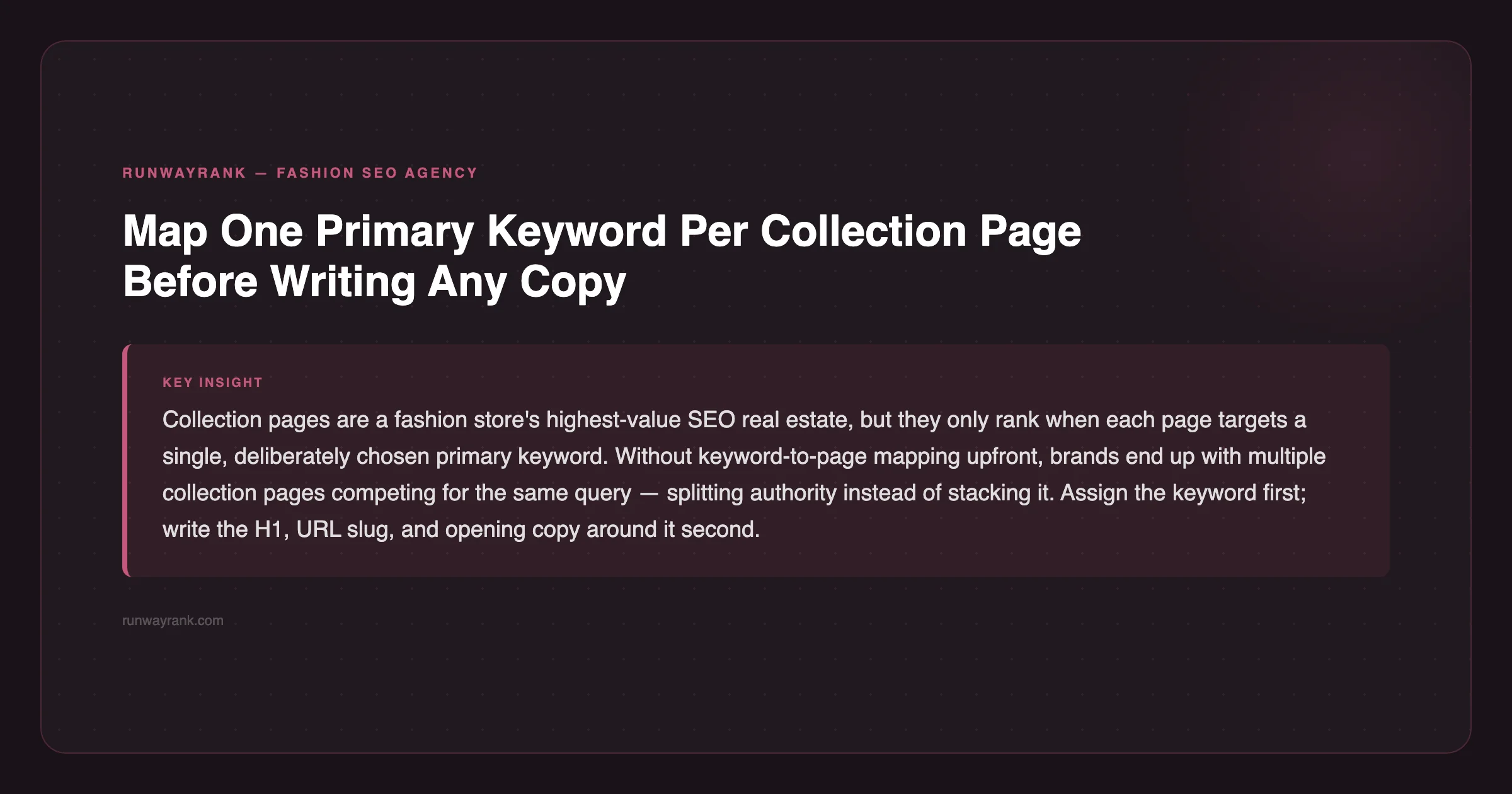
Collection pages are the highest-value SEO real estate on a fashion store. They sit above individual product pages in site architecture, carry more internal link equity, and match the way shoppers search when they are browsing rather than hunting for a specific item.
Start by listing every collection page you have. Then research the keyword phrases shoppers use to find that type of product. Tools like Google Trends reveal how search interest for specific fashion categories shifts across seasons, which is essential data for fashion brands.
Each collection page should target one primary keyword phrase and 2-3 secondary phrases. The primary phrase goes in your H1, URL slug, and first paragraph of any collection description. Secondary phrases appear naturally in the copy below the product grid.
Do not target the same keyword across multiple collection pages. If your “black dresses” and “evening dresses” pages both target “black evening dresses,” they compete with each other. Assign one page as the primary target and link to it from the other.
For a detailed breakdown of keyword selection for fashion, see our post on finding fashion SEO keywords.
Step 3: Build a Seasonal Content Calendar
Fashion brands search traffic follows seasonal patterns. Shoppers search for “summer linen dresses” before summer, not during it. The same logic applies to seasonal drops, holiday dressing content, and trend-driven searches.
Google Trends shows you when search volume peaks for specific categories. Pull the trend data for your 5-10 most important product types and note when volume starts rising. That is when you want your content published and indexed, not when the season actually arrives. For most fashion categories, content should go live 6-8 weeks before peak search volume.
A workable seasonal calendar covers three content types. First, collection page optimization updates before each major season. Second, editorial blog content targeting trend-adjacent searches (“how to style wide-leg trousers” or “what to wear to a garden wedding”). Third, buying guides aligned to seasonal drops (“spring outerwear guide” published in February, not April).
What we consistently see on fashion stores is that brands publish seasonal content too late, after the search volume peak has already passed. Getting ahead of the curve by 6-8 weeks consistently outperforms reactive publishing.
For a deeper look at timing, we cover this in detail in our post on seasonal content timing.
Step 4: Optimize for Google Lens and Visual Search
Visual search is a growing traffic source that most fashion SEO strategies ignore entirely. Google Lens allows shoppers to search by uploading an image or taking a photo. When your product images are optimized correctly, they appear in visual search results alongside or above text-based results.
The optimization is straightforward but often skipped. Use descriptive, keyword-rich alt text on every product image. Include the item type, color, style, and material where relevant. File names should describe the product, not be camera-generated strings. Structured data (specifically, Product schema with image properties) helps Google associate your product images with the right search queries.
Beyond image tags, ensure your images are served in modern formats (WebP or AVIF), load quickly, and are not blocked from crawl by your robots.txt. Google cannot index images it cannot access.
Fashion brands that get this right pick up a meaningful share of visual search traffic that competitors are not competing for. Google Search Central’s image SEO guidance covers image optimization best practices as a baseline starting point.
Step 5: Track, Compound, and Iterate
An SEO strategy only compounds if you track what is working and adjust. Set up a small number of metrics and review them monthly. You do not need a 30-metric dashboard. You need to know which collection pages are gaining or losing organic traffic, which keywords you are ranking for and at what positions, and how your crawl stats are trending in Google Search Console.
When a collection page starts ranking on page 2 or 3, that is your signal to deepen the content, strengthen internal links pointing to it, and check whether the keyword mapping is still accurate. Page 2 rankings are often closer to page 1 than the position number suggests.
The compounding effect in fashion SEO happens when collection pages, seasonal blog content, and visual search all reinforce each other. A well-ranked collection page linked to from a seasonal editorial post, supported by optimized product images, builds authority across multiple signals at once.
In our experience working with fashion brands, this compounding effect becomes visible around months 3-4 for collection pages in low-competition niches, and months 6-9 for more contested terms.
Putting the Steps Together
The order matters. Technical fixes first, then keyword mapping, then content, then visual search, then measurement. Skipping the technical layer and jumping to content means producing work that gets indexed slowly and inconsistently. Skipping keyword mapping means producing content that targets phrases no one searches.
Done in sequence, each step removes a barrier to ranking and makes the next step more effective.
Our SEO services for fashion brands, including strategy work and execution, are built around this same framework. If you want to see how all of this applies to your specific store, the complete fashion SEO guide covers the full picture.
FAQ
How long does it take to build an SEO strategy for a fashion brand?
The strategy itself can be defined in 2-3 weeks: technical audit, keyword mapping, content calendar. Execution takes longer. Most fashion brands start seeing measurable movement on collection pages within 3-6 months, depending on domain age and competition level.
Should fashion brands prioritize product pages or collection pages for SEO?
Collection pages first. They rank faster, carry more internal link equity, and match how shoppers search when browsing. Product pages matter for long-tail, specific-item searches, but collection pages drive the majority of organic traffic for fashion stores. Optimize them before putting effort into individual product descriptions.

SEO strategist with experience in DTC brand growth, including a premium menswear brand scaled to $250K annual revenue and #1 Google rankings for B2B brands entering new markets. Built Runway Rank because every DTC fashion brand I audited had the same fixable problem: their best collection pages were invisible on Google.